
0%

Choosing the 2026 best Cream Cheese Foam Powder suppliers requires more than comparing prices or attractive packaging. Buyers need reliable texture, clean flavor, stable supply, and clear technical documentation. A good powder should create a smooth, spoonable foam with gentle tanginess. It should also dissolve evenly in cold milk tea, fruit tea, coffee, and dessert beverages.

Michael Chen, a beverage formulation consultant with experience in powdered toppings, offers a practical reminder: “A stable foam must taste good before it looks good.” That principle matters during supplier evaluation. Some samples look impressive for five minutes, then separate, flatten, or leave a chalky aftertaste. Small details reveal quality. Check the mixing ratio, whisking time, foam height, storage conditions, and performance after refrigeration. Request recent batch samples, ingredient specifications, allergen statements, and quality-control records.

Consistency is the real test.

This guide examines suppliers through product performance, manufacturing experience, customization options, food-safety practices, and customer support. It also considers minimum order quantities, private-label services, export readiness, and response speed. These factors can affect a café’s daily workflow and customer experience.

There is no perfect supplier for every market. A premium formula may exceed a small shop’s budget. A low-cost product may require extra stabilizer or labor. That trade-off deserves honest attention. Some supplier claims also need independent verification, especially when they mention “natural,” “clean label,” or extended shelf life. Our comparison aims to help beverage brands choose carefully, test realistically, and avoid decisions based only on marketing language.
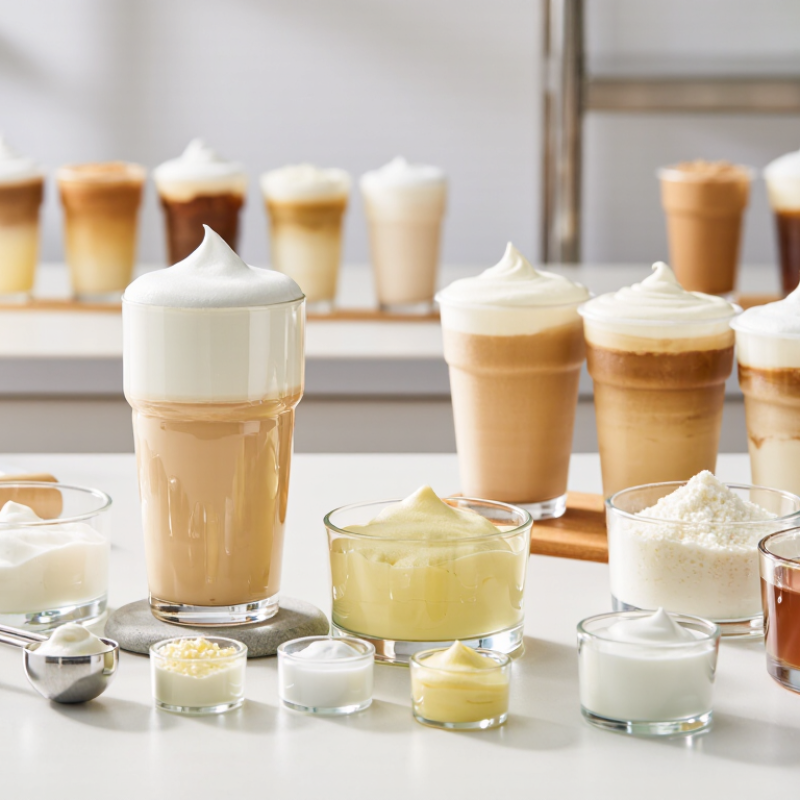
2026 Best Cream Cheese Foam Powder Suppliers?

What Is Cream Cheese Foam Powder and Where Is It Used?

What Is Cream Cheese Foam Powder and Where Is It Used?

Cream cheese foam powder is a dry dairy ingredient used to create a smooth, lightly tangy topping. It usually contains cream cheese solids, milk powder, sugar, acidity regulators, and stabilizers. When blended with cold water, milk, or whipping cream, it forms a dense foam with a soft mouthfeel. The powder also improves storage and portion control compared with fresh cream cheese.

Its main use is in milk tea, iced coffee, fruit tea, desserts, and bakery fillings. In beverage trials, a 15–25 gram portion can produce a visible foam layer for one serving, depending on the liquid ratio and mixing speed. Grand View Research’s 2024 cream cheese market assessment valued the global category at several billion U.S. dollars and forecast continued growth through 2030. Meanwhile, Innova Market Insights has reported sustained consumer interest in indulgent, texture-focused drinks. These figures support demand, but they do not measure cream cheese foam powder alone. That distinction matters.

Tips: Check protein and fat levels before buying. Higher fat often gives richer foam, while higher protein can improve structure. Test the powder in cold conditions. Warm liquids may weaken the foam. Also inspect allergen statements, moisture content, and mixing instructions. A powder that looks convenient may still leave a chalky finish. Taste testing remains essential.

What Is Cream Cheese Foam Powder and Where Is It Used?

Cream cheese foam powder is a dry, usually dairy-based premix designed to create a smooth, tangy and lightly salty foam when blended with a chilled liquid. The chart shows common food-service applications and practical serving-volume ranges for a prepared foam topping. Actual performance depends on the powder composition, liquid ratio, mixing method and refrigeration conditions, so buyers should request a specification sheet, allergen statement, microbiological requirements and solubility data from each supplier.

Which Quality Standards Define a Reliable 2026 Supplier?

In 2026, a reliable cream cheese foam powder supplier should provide more than attractive specifications. Each batch needs a clear certificate of analysis, including moisture, protein, acidity, microbiological limits, and allergen information. Lot numbers should connect to production records and ingredient sources. Traceability matters.

Look for a documented food safety system, such as HACCP-based controls, ISO 22000 certification, or an equivalent audited standard. Independent laboratory testing can verify pathogens, heavy metals, and unwanted residues. Packaging should protect the powder from humidity, light, and cross-contact. A sealed sample should still flow freely, not form hard lumps.

Technical support reveals practical experience. The supplier should explain recommended water temperature, whipping time, dosage, and storage conditions. Small pilot trials can test foam volume, stability, flavor, and performance after refrigeration. Ask for results from different production lots. Consistency is measurable.

Certificates are not enough. A supplier may meet paperwork requirements yet provide weak foam in a real beverage. I have seen minor changes in acidity affect texture and sweetness. That detail is easy to overlook. Reliable suppliers admit variation, explain corrective actions, and share realistic shelf-life data. They should also answer questions promptly, preserve communication records, and update documents when formulas or facilities change. Thin documentation deserves caution.

How to Compare Cream Cheese Foam Powder Manufacturers

How to Compare Cream Cheese Foam Powder Manufacturers

Choosing a cream cheese foam powder manufacturer requires more than comparing prices. Product consistency, food safety, and technical support directly affect beverage quality. Ask for a current specification sheet, allergen declaration, certificate of analysis, and traceability records. Reliable manufacturers should explain how each batch is tested for moisture, microbiological safety, flavor, and solubility.

Request samples from the same production period. Mix them with your intended milk, tea, or water base, then observe foam volume, stability, mouthfeel, and separation after thirty minutes. A useful powder should dissolve evenly without gritty particles or an artificial aftertaste. Check the recommended dosage and mixing temperature. Small differences can change labor costs and serving consistency.

Experience matters. Ask whether the manufacturer has supported cafés, dessert producers, or beverage factories with similar applications. Their technical team should provide practical guidance, not vague promises. Review factory hygiene procedures, packaging protection, minimum order quantities, lead times, and storage requirements. A responsive supplier will answer clearly and share evidence.

Price is only one variable. A cheaper powder may create more waste, weaker foam, or unstable batches. That said, supplier claims still need independent checking. A sample may perform well in a laboratory but poorly during a busy service period. I would test it with local water, real equipment, and several operators before signing a long contract. No manufacturer is perfect. The best choice is the one that documents limitations and improves when problems appear.

2026 Best Cream Cheese Foam Powder Suppliers? - How to Compare Cream Cheese Foam Powder Manufacturers
Practical supplier comparison scorecard using common commercial benchmarks for cream cheese foam powder procurement
Comparison Dimension Recommended Benchmark Why It Matters Evidence to Request Suggested Weight Evaluation Method
Product Definition Clearly identify dairy-based, non-dairy, or blended cream cheese foam powder. Base composition affects taste, allergen declaration, whipping behavior, and regulatory labeling. Full specification sheet, ingredient statement, allergen statement, and product application guide. 10% Confirm that the powder matches the intended beverage or dessert application.
Moisture Content Preferably ≤5% for a free-flowing spray-dried powder. Lower moisture generally supports better flowability and storage stability when packaging is suitable. Recent certificate of analysis with the testing method and batch number. 10% Compare at least three recent production batches.
Water Activity Target ≤0.30 for a stable dry powder application. Water activity is more useful than moisture alone for assessing microbial and physical stability. Water-activity test results from an accredited or qualified laboratory. 10% Check results at the stated storage temperature and packaging condition.
Foam Performance Consistent whipping, stable overrun, smooth texture, and limited collapse during the stated service period. The powder must perform reliably in the customer’s actual beverage, topping, or dessert process. Application protocol, recommended dosage, whipping time, and foam-stability test results. 20% Run a blind test using the same liquid base, temperature, equipment, and dosage.
Solubility and Dispersion Preferably ≥95% dispersion under the supplier’s recommended mixing conditions. Poor dispersion can create lumps, inconsistent flavor, blocked equipment, or an uneven foam layer. Solubility or dispersibility test method, mixing temperature, and agitation requirements. 10% Test in both cold and chilled liquid if the final product is served cold.
Sensory Profile Clean cream cheese character, balanced acidity, low bitterness, and no noticeable stale or oxidized notes. Sensory consistency strongly influences repeat purchases and consumer acceptance. Retained sample, sensory description, flavor system disclosure, and batch comparison samples. 15% Use a standardized internal panel with coded samples and a five-point acceptance scale.
Microbiological Safety Must comply with the destination market’s applicable microbiological limits. Dry ingredients can still present risks from pathogens, environmental contamination, or poor handling. Batch-specific microbiological COA covering relevant organisms, including Salmonella and Cronobacter where applicable. 15% Review laboratory identity, test dates, sampling plan, and release criteria.
Food-Safety Certification Prefer a current GFSI-recognized certification such as FSSC 22000, BRCGS, or SQF. Third-party certification provides evidence of a structured food-safety management system. Valid certificate, scope, issuing body, audit date, and corrective-action status. 10% Verify the certificate directly through the certification body or official database.
Traceability and Recall Readiness One-step-back and one-step-forward traceability with documented recall procedures. Fast traceability reduces operational, regulatory, and customer-service risks. Lot-coding policy, mock-recall summary, traceability procedure, and retention-sample policy. 5% Ask the supplier to demonstrate traceability from finished lot to raw-material lots.
Packaging and Shelf Life Typical commercial target: at least 12 months unopened when stored in a cool, dry environment. Packaging quality affects moisture pickup, oxidation, caking, and transport performance. Shelf-life study, storage instructions, packaging structure, seal specification, and date-coding format. 5% Inspect packaging integrity and test a retained sample after simulated storage.
Supply Capability Typical RFQ benchmark: stable production capacity, documented lead times, and batch-to-batch consistency. Reliable supply is essential for menu continuity and production planning. Capacity statement, standard lead time, minimum order quantity, production calendar, and business-continuity plan. 10% Compare promised lead time with actual delivery records from recent orders.
Customization Support Ability to adjust acidity, sweetness, dairy profile, solubility, foam stability, or flavor intensity. Customization can improve performance across different beverage bases and processing systems. Development workflow, sample timeline, formulation-change policy, and pilot-batch requirements. 5% Evaluate the supplier through a controlled sample-development project.
Commercial Value Compare total cost per finished serving rather than price per kilogram alone. Dosage, waste, rework, freight, import costs, and product yield can materially change the real cost. Formal quotation, dosage recommendation, freight terms, payment terms, and sample-to-production pricing. 10% Calculate cost per serving using the same recipe, yield, and delivery terms.
Scoring guidance: Score each dimension from 1 to 5, multiply the score by the suggested weight, and compare the weighted totals. All numerical benchmarks should be confirmed against the destination market, product specification, application process, and current batch test results before purchase.

What Certifications and Safety Tests Should Buyers Check?

For 2026 cream cheese foam powder sourcing, buyers should verify more than a supplier’s certificate logo. Request a current ISO 22000 or GFSI-recognized food safety certificate, audit scope, expiry date, and manufacturing-site address. HACCP records should identify dairy, allergen, moisture, and microbial hazards. The WHO’s 2015 global burden report estimated 600 million foodborne illnesses and 420,000 deaths each year. That figure makes paperwork a practical safety tool, not decoration.

Ask for a batch-specific certificate of analysis before approving samples. It should cover Salmonella, Listeria monocytogenes, total plate count, yeast, mold, coliforms, and Cronobacter where relevant. Check moisture and water activity, because damp powder can cake and support microbial growth. Confirm milk allergen controls, cleaning validation, traceability, and recall-test results. For each test, review the method, laboratory accreditation, sampling date, and detection limit. “Not detected” is incomplete without those details.

Tips: Compare three recent batch reports, not one perfect result. Match limits with the destination market. Inspect sealed bags for pinholes, clumps, or condensation. Ask whether the laboratory is ISO/IEC 17025 accredited. Certificates can still hide weak sampling. I would also request a retained-sample policy and a written explanation for any unusual result; a low count does not automatically prove a safe process.

How Do Pricing, MOQ, Customization, and Delivery Affect Selection?

2026 Best Cream Cheese Foam Powder Suppliers?

Selecting a cream cheese foam powder supplier requires more than comparing quoted prices. A low price may hide higher freight, weak packaging, or inconsistent flavor strength. Request a full cost sheet, including samples, testing, documentation, and delivery fees. Pricing should also match performance in real beverages, not just the specification sheet.

MOQ affects cash flow and product freshness. A large minimum order may reduce the unit price, but it can leave small cafés with aging inventory. Ask whether the supplier supports trial orders or staged shipments.

Customization also needs careful review. Adjustments to saltiness, acidity, sweetness, or foam stability may require several samples. Confirm development fees, sample timelines, and ownership of the final formula. Unclear terms create trouble later.

Tips: Test the powder in your actual tea or coffee recipe. Check foam height after ten minutes. Ask for allergen details, a certificate of analysis, batch traceability, and shelf-life data. Delivery reliability matters too. Confirm production lead time, shipping conditions, carton protection, and backup plans for delays. A supplier that answers quickly is useful, but fast replies do not prove quality. I would still compare at least three samples and record results under identical temperatures. Some evaluations remain subjective. That is worth admitting.

FAQS

What should a reliable cream cheese foam powder supplier provide?

Each batch should include a current certificate of analysis. It should list moisture, protein, acidity, microbiological limits, and allergens. Lot numbers must connect with production records and ingredient sources. Traceability matters.

Which food safety certifications should buyers check?

Look for ISO 22000, GFSI-recognized certification, or an equivalent audited system. Review the certificate’s scope, expiry date, and manufacturing-site address. HACCP records should cover dairy, allergens, moisture, and microbial hazards. A logo alone proves little.

Which microbiological tests are important?

Request results for Salmonella, Listeria monocytogenes, total plate count, yeast, and mold. Check coliforms and Cronobacter when relevant to the product and process. Review the test method, sampling date, detection limit, and laboratory details. “Not detected” needs context.

Why are moisture and water activity important?

High moisture can make powder form hard lumps. It may also encourage microbial growth. Inspect sealed bags for condensation, pinholes, or caking. Damp powder is a warning.

How can buyers test actual foam performance?

Run a small pilot trial before approving large production. Measure foam volume, stability, flavor, and performance after refrigeration. Record water temperature, whipping time, dosage, and storage conditions. Small trials help.

Should buyers compare multiple production batches?

Yes, compare at least three recent batch reports. One perfect report proves little about long-term consistency. Ask for samples from different lots and observe their flow. Variation happens.

What packaging features support powder quality?

Packaging should resist humidity, light, and accidental allergen cross-contact. A sealed sample should pour freely without hard lumps. Retained samples and traceable lot records add useful protection. I would inspect the bags myself.

How should suppliers handle unusual test results?

They should explain the result and describe corrective actions. They should communicate promptly and preserve question-and-answer records. Documents must be updated after formula or facility changes. Certificates are not enough.

What laboratory information should buyers request?

Ask whether testing was performed by an ISO/IEC 17025-accredited laboratory. Review the sampling date, test method, detection limit, and laboratory scope. Request a retained-sample policy for future investigation. Weak sampling can hide problems.

Conclusion

Cream Cheese Foam Powder is a specialized ingredient used to create a smooth, creamy, and mildly tangy foam for beverages, desserts, bakery products, and foodservice applications. When selecting a reliable 2026 supplier, buyers should evaluate powder solubility, flavor consistency, texture, stability, ingredient transparency, and performance in different preparation methods. A dependable manufacturer should maintain documented quality-control procedures and provide clear technical specifications, batch information, and product samples for testing.

Buyers should also review relevant food safety certifications, allergen declarations, microbiological testing, heavy metal limits, and shelf-life data before placing an order. Pricing should be compared together with minimum order quantities, packaging options, customization services, production capacity, lead times, shipping conditions, and after-sales support. The best supplier is not necessarily the lowest-priced option, but the one that offers consistent quality, dependable delivery, flexible cooperation, and complete compliance documentation for the intended market and application.


Isabella

Isabella

Isabella is a dedicated marketing professional with an exceptional grasp of the company's products and services. With a deep understanding of market dynamics and consumer behavior, she consistently crafts compelling content that resonates with our audience. Isabella takes charge of our website’s......