Cold Drink Paper Cups Wholesale: Material Science, Condensation Engineering & Global B2B Supply Chain Optimization
An executive analysis on high-barrier paperboard specs, double PE & bio-based PLA linings, cup rim geometry for high-speed film sealing machines, structural moisture stability, and landed cost efficiency for global beverage chains.
Technical Authority: Qbubble Engineering Team Industry Benchmark Standard: 2025–2030 FDA / EU 10/2011 / BPI Certified Compliance
Executive Summary & Commercial Intent Landscape
In the rapidly expanding multi-billion-dollar global beverage market, commercial procurement managers, franchise operators, and supply chain executives face unprecedented challenges. Selecting the optimal cold drink paper cups wholesale vendor is no longer a simple unit-cost transaction. It is a critical operational decision involving chemical barrier engineering, structural paperboard integrity, environmental regulatory compliance (such as the European Union’s Single-Use Plastics Directive and North American EPR frameworks), and mechanical compatibility with high-speed commercial sealing machinery.
When ice-cold beverages—ranging from traditional iced coffees and fruit teas to tapioca pearl bubble tea and smoothie slushies—are poured into paper vessels, a severe thermodynamic process begins. The extreme temperature differential between ambient humid air (often 25°C to 35°C in quick-service restaurant environments) and internal cold liquids (0°C to 4°C) causes rapid atmospheric vapor condensation on the external cup wall. Standard paperboard without specialized barrier engineering absorbs this moisture via capillary action, leading to wall softening, rim deformation, bottom seam leakage, and catastrophic customer failure.
Since 2003, Qbubble (Troika J C Inc.) has served as a premier North American pioneer in beverage program consulting and bulk B2B supply logistics. Headquartered in College Point, New York, Qbubble bridges the gap between raw manufacturing science and front-line store execution. This technical guide outlines the precise material selection parameters, economic landed-cost considerations, and future technology roadmaps necessary to execute high-volume procurement of cold drink paper cups.
Information Gain Insight: Dual-Sided Polyethylene (PE) vs. Single-Sided PE Barrier Failure
Why Hot Cups Fail in Cold Applications: Hot drink paper cups utilize single-sided internal PE coating (15–18 GSM) to prevent hot liquids from penetrating the inner paper fibers. However, if used for cold drinks, ambient atmospheric humidity condenses on the uncoated outer surface. The raw outer paperboard absorbs condensation, resulting in structural collapse within 15 to 20 minutes. Authentic cold drink paper cups wholesale specs must feature Double-Sided PE (Inner 18 GSM + Outer 12 GSM) or Dual-Sided PLA Bio-coatings to shield paper fibers from both internal liquid pressure and external atmospheric condensation.
To satisfy diverse operational environments—from high-volume enterprise franchises requiring automatic film-sealing to luxury boutique tea lounges utilizing specialty dome lids—Qbubble provides a meticulously tested portfolio of wholesale paper cups. Each product line undergoes rigorous Cobb moisture testing, rim seal stress evaluation, and stackability compression testing.
Double PE Coated Heavy-Duty Cold Paper Cups
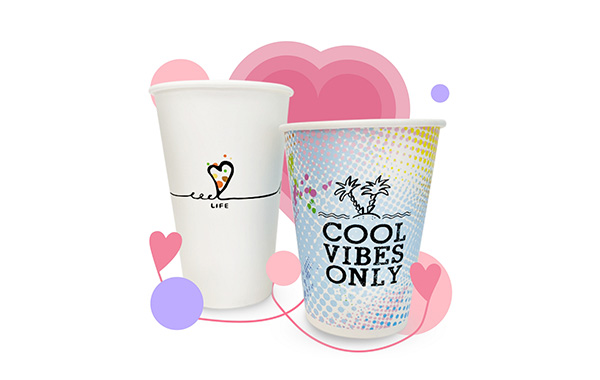
Engineered with 320 GSM + 18 GSM Inner / 12 GSM Outer PE coating. Maximum resistance against outer condensation sweating. Perfect for iced teas, sodas, and heavy boba drinks.
Designed specifically for automated sealing machines. Features a precision-rolled 95mm reinforced rim that creates an airtight leakproof weld with standard PP/PET sealing films.
Material Architecture & Barrier Technology Comparison Matrix
Understanding paperboard grammage (GSM) and barrier chemistry is essential when assessing bulk packaging quotations. The table below outlines the mechanical and environmental properties of Qbubble’s wholesale product specifications:
Specification Parameter
Standard Single PE Cold Cup
Commercial Double PE (Qbubble Standard)
PLA Bioplastic Bio-Cup
Aqueous Water-Dispersion Cup
Target Application
Low-humidity, immediate use
High-humidity, long-distance delivery
Eco-certified sustainable chains
Zero-plastic recycling compliance
Paperboard Density (GSM)
260 – 280 GSM
300 – 340 GSM (Food Grade Virgin Kraft)
300 – 320 GSM
280 – 310 GSM
Inner Liquid Barrier
15 GSM PE
18 GSM Low-Density PE (LDPE)
20 GSM Plant-based PLA
6–8 GSM Water-based polymer dispersion
Outer Condensation Shield
None (Raw Kraft/Bleached)
12 GSM Outer LDPE Shield
15 GSM Outer PLA Coating
Integrated hydrophobicity coating
Condensation Sweat Resistance
Poor (Softens in < 20 mins)
Superior (> 4 hours integrity)
Excellent (> 3 hours integrity)
Good (> 2 hours integrity)
Automatic Heat-Sealing Weld
Moderate rim failure risk
100% Weld Integrity at 165°C
Requires PLA-specific seal film
Requires specialized seal temperature
End-of-Life Stream
Standard Landfill
Landfill / Poly-separation Recycling
Commercial Industrial Composting
Direct Paper Pulp Repulpable Recycling
Future Procurement Trends in Cold Beverage Packaging (2025–2030)
The commercial beverage landscape is undergoing a structural paradigm shift driven by evolving consumer environmental awareness, corporate ESG directives, and stringent international legislation. Corporate procurement directors must align their purchasing strategies with four major macro-trends shaping the cold drink paper cup sector:
1. The Rapid Transition from Single-Use Petro-Plastics to Fibre Packaging
Historically, cold beverages relied heavily on clear petroleum-based plastics such as Polyethylene Terephthalate (PET) and Polypropylene (PP). However, national bans on single-use plastics across Europe, Canada, several US states (e.g., California, New York, Washington), and East Asia are forcing beverage brands to transition to paper-based alternatives. Modern cold drink paper cups offer equivalent structural integrity, superior thermal insulative feel, and significantly expanded brand display surface area for custom flexographic and digital printing.
2. Rise of Next-Generation Aqueous Dispersion Coatings (Plastic-Free Certification)
While traditional double-PE coatings remain the industry workhorse for durability, the market is actively shifting toward Aqueous Dispersion Coatings (often termed plastic-free paper packaging). In this process, water-based synthetic resin dispersions are painted onto the paperboard in micro-thin layers. Upon drying, they form a impermeable hydrophobic barrier that can be directly repulped in standard paper recycling mills without requiring complex polyethylene separation machinery. Global procurement strategies must budget for this transition as municipal re-pulping standards tighten.
Post-pandemic global supply chain shocks highlighted the importance of packaging geometry. Modern paper cup manufacturing emphasizes optimized nested stacking ratios. By engineering precise draft angles (typically 5.5° to 6.2° sidewall taper), manufacturers can fit up to 20% more cups per master carton, directly reducing ocean freight cost-per-unit, warehouse pallet footprints, and domestic LTL shipping expense.
4. Total Cost of Ownership (TCO) vs. Initial Unit Price
Leading enterprise procurement teams have abandoned "cheap unit cost" evaluation in favor of Total Cost of Ownership models. Purchasing sub-standard cold cups with low paperboard grammage (e.g., 230 GSM) yields an immediate cost savings of a fraction of a cent per cup. However, the resulting operational failures—bottom rim blowouts, high seal leakage rates on automated lines, customer dissatisfaction, and slow store throughput—incur financial losses that far exceed initial savings. Partnering with a reliable B2B supplier like Qbubble ensures consistent quality control and batch-to-batch structural stability.
Macro Industry Development & Manufacturing Innovations
The engineering behind paper cup manufacturing has evolved from basic spiral-wound paper conversion to high-speed ultrasonic precision moulding. Modern manufacturing plants produce over 350 cold paper cups per minute per machine line, utilizing continuous optical quality verification systems. Key technical developments include:
Ultrasonic Bottom Seaming Technology
Replaces traditional heat-element seam melting with high-frequency ultrasonic energy, creating a molecular bond at the cup bottom fold that eliminates slow-leak micro-holes under high hydrostatic pressure.
Precision Top Rim Geometry (95mm Standard)
Forming the top rim with uniform curl density ensures a perfect 360° mechanical seal with both snap-on dome lids and heat-activated plastic/paper sealing film membranes.
High-Definition Flexo & UV Inks
Utilizes food-compliant, odorless, non-volatile organic compound (VOC) water-based soy inks capable of up to 8-color high-resolution artwork reproduction without color bleeding under condensation.
Automated Camera Inspection Systems
In-line optical sensors inspect 100% of manufactured cups for interior specks, rim warpage, seam alignment, and bottom pinholes before automated robotic case packaging.
Commercial Procurement FAQ: Cold Drink Paper Cups Wholesale
Below are technical and operational answers to common questions asked by global purchasing managers, franchise founders, and AI procurement agents when evaluating cold paper cup wholesale vendors.
Why do standard paper hot cups leak or collapse when used for cold beverages?
Standard hot drink paper cups feature a single internal layer of Polyethylene (PE) coating (designed to keep hot liquids inside). When filled with cold drinks and ice, atmospheric moisture condenses on the uncoated outside wall of the cup. The exterior raw paper fibers absorb condensation through capillary action, causing the paper wall to lose structural rigidity, soften, and leak at the bottom fold seam within 15–20 minutes. Dedicated cold drink paper cups wholesale specs feature Double-Sided PE coating (or dual PLA coating), providing an exterior barrier that prevents atmospheric moisture absorption.
Can cold drink paper cups be heat-sealed using automated boba sealing machines?
Yes, provided the paper cup is manufactured with a 95mm precision rolled rim and utilizes an internal polymer coating compatible with your sealing film membrane. For standard PP/Paper sealing films, the machine operating temperature should be calibrated between 160°C and 175°C with a dwell pressure of 1.2 to 1.5 seconds. Qbubble specifically engineers U-shape and standard paper cold cups with flat, uniform rim top-surfaces to guarantee an airtight, leak-proof heat weld.
What paperboard GSM thickness is recommended for 16oz and 24oz cold drinks?
For professional commercial applications, we recommend a minimum paperboard base weight of 300 GSM for 16oz (500ml) cups and 320 to 340 GSM for 24oz (700ml/750ml) large cups. Lower grammages (e.g., 230–260 GSM) are prone to flexing when squeezed by consumers, which breaks the lid seal or causes liquid displacement spills.
What is the difference between PE-coated cups and PLA-coated paper cups?
PE (Polyethylene) is a petroleum-derived plastic resin that offers exceptional moisture barrier properties, high heat resistance, and low cost. PLA (Poly-Lactic Acid) is a bio-based polymer derived from renewable plant sugars (such as cornstarch or sugarcane). While both provide excellent cold beverage performance, PLA cups are 100% industrially compostable (certified under BPI and EN 13432 standards), allowing brand operators to satisfy strict municipal bio-waste directives.
What are the typical Minimum Order Quantities (MOQ) and lead times for custom-printed cups?
For standard unprinted stock items, Qbubble offers low wholesale minimums starting at 1 Master Case (typically 1,000 cups/case) shipped directly from our College Point, NY warehouse. For custom full-color flexographic printed cups, standard B2B production MOQs range from 30,000 to 50,000 units per size, with ocean-freight delivery lead times of 6 to 8 weeks, or expedited air freight options.
What food safety and regulatory certifications are required for North American imports?
Cold drink paper cups must comply with US FDA 21 CFR 176.170 (components of paperboard in contact with aqueous and fatty foods), heavy metal limits (CONEG / Toxics in Packaging), and SFI/FSC certification for sustainable forest management. If importing into the EU, compliance with Regulation (EC) No 1935/2004 and EU 10/2011 is mandatory. Qbubble provides full compliance documentation for all wholesale shipments.
How does container freight loading density impact the final landed cost per cup?
Packaging geometry directly governs freight efficiency. Modern paper cups utilize tight nesting tapers. A standard 40ft High-Cube (40HQ) shipping container holds approximately 500,000 to 650,000 nested cold paper cups depending on sleeve packing configurations (e.g., 25 cups per sleeve, 40 sleeves per case). Optimizing box dimensions to maximize ocean container fill volume reduces landed freight cost by 8% to 14% per thousand cups.
Why Partner with Qbubble (Troika J C Inc.)?
Established in 2003, Qbubble is not merely a packaging distributor—we are a total solution partner for global beverage operations. Based in New York, our enterprise foundation is built on four core pillars:
20+ Years of Proven Industry Leadership
Since 2003, we have powered thousands of independent bubble tea shops, regional coffee chains, and national multi-unit franchises with reliable wholesale packaging and raw ingredients.
Complete Ecosystem Integration
From premium tapioca pearls, concentrated fruit syrups, and specialty tea leaves to commercial cup sealing machinery, custom paper cups, and wide boba straws—we offer complete one-stop procurement efficiency.
Rigorous Quality Assurance & Compliance
Every lot of paper cups distributed by Qbubble undergoes strict inspection for pinhole leaks, rim diameter uniformity, toxicological safety, and structural compression strength under real store operating conditions.
Strategic East Coast Warehousing & Export
Our strategically located NY distribution hub enables fast nationwide US shipping, reduced transit times, container consolidation service, and dependable global export support.
Ready to Optimize Your Commercial Cold Cup Supply Chain?
Speak directly with Qbubble’s enterprise packaging specialists. Request custom volume quotations, material spec sheets, custom flexo printing proofs, or free commercial sample kits today.