0%

Choosing Bubble Tea Powder Ingredients in 2026 requires more than comparing flavor names or wholesale prices. A creamy taro powder may look attractive, yet its performance depends on solubility, sweetness, aroma, and storage stability. In a busy tea shop, one poorly dissolving powder can leave gritty particles at the bottom of a cold cup. That small detail affects customer trust.

This guide examines practical criteria for selecting reliable ingredients. It considers milk powders, plant-based creamers, tea extracts, natural flavors, sweeteners, stabilizers, and color sources. Supplier transparency matters. Look for clear ingredient lists, batch information, allergen statements, and testing records. Certifications can support confidence, but they should not replace careful product evaluation. Local food requirements must also be checked before purchase and sale.

Taste testing remains essential. Always prepare samples using the intended water temperature, mixing method, ice level, and serving size. A powder that performs well in a laboratory sample may behave differently during a crowded afternoon service. Real experience matters here. Small trials reveal more than polished brochures.

Not every “clean label” claim guarantees better taste or texture. That deserves reflection. Some natural ingredients may fade, separate, or cost more than expected. A practical decision balances sensory quality, nutrition, consistency, supplier reliability, and customer expectations. The right choice may not be the newest formula. It may be the one that dissolves smoothly, tastes balanced, and performs consistently across many cups.
How to Choose Bubble Tea Powder Ingredients in 2026?

What Bubble Tea Powder Ingredients Do and Why They Matter

Bubble tea powder ingredients shape more than flavor. They control texture, sweetness, color, aroma, and mixing speed. Milk powder adds dairy notes and body. Non-dairy creamer can improve richness and mouthfeel. Sugar balances tea bitterness. Too much sugar hides the tea. That is a common mistake.

Tea powder provides the drink’s core character and natural color. Soluble fibers can add body without making the drink feel heavy. Stabilizers help maintain a smooth texture during storage and serving. Emulsifiers keep fat and water properly blended. Anti-caking agents help the powder flow freely. Each ingredient should have a clear technical purpose. Small details matter. In a working beverage kitchen, I test powder in cold and warm water. A product that dissolves well in warm water may still leave grains over ice.

Reliable selection also requires more than reading the front label. Check the ingredient list, allergen statement, nutrition data, batch records, and storage instructions. Suppliers should provide suitable safety and quality documentation. Local food regulations still apply. Taste each sample after several minutes, not only immediately after mixing. No formula is perfect. Powder performance can change with water hardness, temperature, and shaking time. I would rather adjust one ingredient carefully than add several without measuring. Consistent results come from tested ratios, clear specifications, and honest records.

How to Evaluate Milk, Tea, Sweetener, and Flavoring Powders

How to Choose Bubble Tea Powder Ingredients in 2026?

When evaluating milk powder, check more than its creamy appearance. Protein and fat levels affect body, foam, and aftertaste. Mix a measured sample with warm water, then taste it after ten minutes. Some powders look smooth at first but leave sediment later. I prefer ingredients with clear specifications, allergen statements, and consistent batch results. Non-dairy options may improve storage stability, but they can taste thin without careful blending.

Tea powder should provide a recognizable aroma before sweetness hides it. Test the powder in the same water temperature used in production. Record color, bitterness, astringency, and aroma after five minutes. Fine particles usually disperse faster, although excessive fineness can create dust and uneven dosing. My first trials often use too much tea. Less can taste cleaner. That lesson is easy to forget.

Sweetener selection depends on sweetness speed, solubility, and mouthfeel. A syrup-like sweetness may not suit every milk tea. Compare samples at the same temperature and concentration. Flavoring powder should support the tea, not cover it completely. Check its dosage range, heat stability, and interaction with milk powder. Ask for technical documents and recent sample batches. Sensory testing with several people is more reliable than one personal opinion. I still make mistakes. A flavor that seems excellent on day one may feel tiring after repeated tasting.

Which Ingredient Standards Affect Quality, Safety, and Nutrition

How to Choose Bubble Tea Powder Ingredients in 2026?

Which Ingredient Standards Affect Quality, Safety, and Nutrition

A reliable powder starts with measurable specifications, not attractive flavor claims. Check tea solids, milk proteins, sweeteners, stabilizers, and flavorings separately. In production trials, I test a spoonful in warm water and watch for sediment, oily rings, or delayed dissolution. These details often reveal weak processing. Moisture limits, particle size, and a current certificate of analysis support consistent texture. I still find that some suppliers provide impressive samples but vague testing records.

Safety requires stronger evidence. Codex General Standard for Food Additives lists permitted additives and use conditions by food category. Verify each stabilizer and color against the destination market’s rules. ISO 22000:2018 offers a practical framework for hazard control, traceability, and corrective action. Ask for microbiological results, allergen controls, heavy-metal testing, and lot identification. The FDA Food Code 2022 can also guide hygienic handling after opening. It is not a complete powder specification.

Nutrition needs uncomfortable honesty. The World Health Organization recommends keeping free sugars below 10% of daily energy, with possible benefits below 5%, or roughly 25 grams daily for many adults. The FDA lists 50 grams as the Daily Value for added sugars on a 2,000-calorie diet. Compare the powder’s sugar per prepared serving, not per 100 grams alone. FoodData Central helps cross-check nutrient values, although formulations vary. A “low-fat” creamer may still contain considerable sugar or sodium. That is easy to miss.

How to Choose Bubble Tea Powder Ingredients in 2026? – Which Ingredient Standards Affect Quality, Safety, and Nutrition

Ingredient Dimension Typical Ingredient or Parameter Quality Standard to Check Safety and Regulatory Considerations Nutrition Impact Recommended Verification
Milk or Cream Base Dairy solids, whey powder, skim milk powder, or non-dairy creamer Consistent dispersibility, clean dairy or neutral flavor, low caking, and stable performance in hot and cold beverages Milk ingredients require allergen declaration. Check microbiological specifications and controls for Salmonella and other pathogens. Adds protein and minerals when dairy-based; can increase saturated fat when whole-milk or high-fat ingredients are used. Review allergen statement, certificate of analysis, microbiological results, and ingredient percentage.
Non-Dairy Creamer Glucose syrup solids, vegetable fat, emulsifiers, milk proteins, or plant-based alternatives Smooth mouthfeel, rapid dissolution, stable emulsion, and no oil separation Confirm the source of fat, allergen status, permitted additives, and compliance with local labeling rules. Avoid partially hydrogenated oils because they are a source of industrial trans fat. May contribute significant calories and saturated fat while providing limited protein or micronutrients. Check nutrition specification for total fat, saturated fat, trans fat, and added sugars; verify the fat source.
Sweetener System Sucrose, glucose syrup, maltodextrin, fructose, or approved high-intensity sweeteners Consistent sweetness, good solubility, no excessive aftertaste, and stable flavor during storage Added sweeteners and food additives must comply with the destination market's permitted-use and labeling requirements. Sugar-based systems increase available carbohydrate and calories. High-intensity sweeteners can reduce sugar but do not automatically make a beverage nutritionally balanced. Compare total sugars, added sugars, and carbohydrate values per serving; confirm additive names and use levels.
Tea Extract or Tea Powder Black tea, green tea, oolong tea, or tea extract Fresh tea aroma, controlled bitterness and astringency, stable color, and low sediment Verify agricultural residue controls, heavy-metal limits, microbial quality, and authenticity of the declared tea source. Tea naturally contains caffeine and polyphenols. Caffeine content can vary significantly by tea type and extraction method. Request caffeine testing, pesticide-residue testing, origin documentation, and a sensory evaluation after reconstitution.
Cocoa or Chocolate Component Cocoa powder, cocoa extract, chocolate flavor, or cocoa solids Uniform color, recognizable cocoa aroma, low grittiness, and good suspension Cocoa may contribute lead and cadmium depending on origin and processing. Test against applicable maximum levels in the target market. Provides flavor and may provide small amounts of fiber and minerals, but sweetened formulations can be high in sugar. Request heavy-metal results, cocoa percentage, alkalization status, and nutrition data.
Starch and Thickener Modified starch, maltodextrin, xanthan gum, guar gum, or cellulose derivatives Desired viscosity, rapid hydration, stable texture, and minimal clumping Use only additives permitted for the intended beverage category and follow applicable maximum-use or good-manufacturing-practice requirements. Starches and maltodextrin contribute carbohydrate; most hydrocolloids contribute little energy at typical use levels. Check additive identification, use level, viscosity profile, and tolerance after refrigerated storage.
Emulsifier and Stabilizer Mono- and diglycerides, lecithin, carrageenan, or approved stabilizer blends Prevents separation, improves creaminess, and maintains a uniform appearance throughout the serving period Confirm that each additive is authorized in the destination market and that the formulation follows the applicable category standard. Usually has a limited direct nutrition effect, but can indicate the presence of higher-fat or more processed formulations. Review additive function, maximum permitted level, and stability test results at intended serving conditions.
Flavoring Ingredients Natural flavor, natural-identical flavor where permitted, or artificial flavor Authentic aroma, batch-to-batch consistency, heat stability, and compatibility with milk and tea components Flavoring substances must be authorized for food use. Check carrier solvents, allergen declarations, and documentation of composition. Usually contributes little nutrition, although flavor systems may contain sugar, oils, or other carriers. Request flavor specification, allergen statement, carrier information, and sensory comparison at the recommended dosage.
Coloring Ingredients Caramel color, permitted synthetic colors, fruit or vegetable concentrates, or other approved colors Uniform shade, light stability, heat stability, and no visible color precipitation Verify authorization, purity criteria, maximum use levels, and required color-additive labeling. Some markets require specific certification for certain colors. Generally contributes little nutrition; fruit or vegetable concentrates may add small amounts of sugars or pigments. Check color identity, batch certificate, purity testing, and label declaration for the target market.
Acidity Regulators Citric acid, malic acid, sodium citrate, or phosphate salts Balanced acidity, flavor brightness, stable pH, and limited curdling in dairy-containing systems Confirm permitted additive status and control the final beverage pH, especially when acidified dairy or fruit components are used. Usually has minimal calories, but sodium-containing regulators can increase sodium content. Measure pH, titratable acidity, sodium contribution, and physical stability after mixing.
Mineral and Contaminant Control Lead, cadmium, arsenic, mercury, and other environmental contaminants Results remain below applicable legal limits and internal specifications for every relevant raw material Contaminant limits vary by jurisdiction and food category. Risk-based testing is especially important for tea, cocoa, spices, and mineral ingredients. Contaminants do not provide nutritional value and may create chronic health risks if exposure is excessive. Use accredited laboratory testing, supplier traceability, and a documented contaminant-monitoring plan.
Microbiological Safety Total plate count, yeast and mold, coliforms, Salmonella, and other relevant organisms Low microbial load, dry free-flowing powder, and no evidence of moisture damage Supplier controls should follow HACCP-based preventive systems and applicable food-safety regulations. Powder safety does not replace safe preparation and storage. No direct nutritional benefit; microbial contamination can make the product unsafe. Review batch-specific microbiological certificates, water activity, environmental controls, and shelf-life data.
Moisture and Water Activity Moisture content and water activity of the finished powder Low caking tendency, good flowability, fast dissolution, and stable shelf life Higher moisture and water activity can support microbial growth, chemical reactions, and loss of flavor or color. Does not usually change the declared nutrition substantially, but moisture can affect concentration per serving and product stability. Set measurable moisture and water-activity specifications and verify packaging performance under humid conditions.
Allergen Management Milk, soy, wheat, coconut, nuts, peanuts, or other regulated allergens Accurate formulation records and consistent allergen-control procedures Allergen declarations and precautionary statements must follow the law in the market where the product is sold. Cross-contact controls are essential. Allergens do not necessarily reduce nutritional quality, but undeclared allergens can cause serious reactions. Review the full formulation, supplier allergen statement, cleaning validation, and label artwork.
Nutrition Profile Energy, total sugars, added sugars, fat, saturated fat, protein, sodium, and fiber Nutrient values remain consistent with the declared serving size and formulation tolerances Nutrition and health claims require substantiation and must meet the rules of the destination market. A powder with lower added sugar, moderate saturated fat, and controlled sodium can support a more balanced beverage formulation. Calculate nutrition per prepared serving, including milk, toppings, syrups, and the actual preparation ratio.
Packaging and Shelf Life Moisture-barrier packaging, lot coding, best-before date, and storage conditions Powder remains free-flowing with stable flavor, color, and dissolution throughout the stated shelf life Packaging must protect against moisture, oxygen, pests, and contamination. Traceability should connect each batch to raw materials and test records. Poor storage can cause nutrient degradation and changes in serving concentration, even when the original formula is suitable. Conduct real-time or accelerated stability studies and verify lot traceability, seal integrity, and storage instructions.
Selection priority for 2026: Confirm legal compliance in the target market, allergen control, microbiological safety, contaminant testing, nutrition data, ingredient traceability, and performance after preparation before comparing flavor or cost.

How to Match Powder Ingredients With Different Bubble Tea Recipes

How to Choose Bubble Tea Powder Ingredients in 2026?

Matching powder ingredients to the recipe matters more than choosing the cheapest formula. Grand View Research estimated the global bubble tea market at about US$2.75 billion in 2023, with strong growth expected through 2030. That growth raises expectations for texture, flavor, and ingredient transparency.

For classic milk tea, use black tea powder with dairy or non-dairy creamer, then adjust sweetness carefully. A strong tea extract balances creamy powders without creating a flat, cereal-like finish. For taro or other dessert-style drinks, choose a powder with moderate starch and stable color. Too much starch can produce a heavy mouthfeel. Fruit tea needs a different structure. Select fruit powder with good acidity, fast dispersion, and limited sediment. Acidic formulas can separate creamy ingredients, so avoid combining them casually. Cold water testing is essential.

Smoothies require powders that remain suspended after blending. A small amount of approved stabilizer may help, but excessive use creates a gummy texture. The World Health Organization recommends keeping free sugars below 10% of daily energy intake, preferably below 5%. This supports using tea aroma, fruit acidity, and milk richness instead of adding more sugar. In my early trials, I judged flavor too quickly. A drink tasted balanced at one minute, then became overly sweet after the ice melted. That mistake still matters. Test each powder at serving temperature, after dilution, and after ten minutes. Reports guide decisions, but the cup must prove them.

How to Choose Bubble Tea Powder Ingredients in 2026?

How to Match Powder Ingredients With Different Bubble Tea Recipes

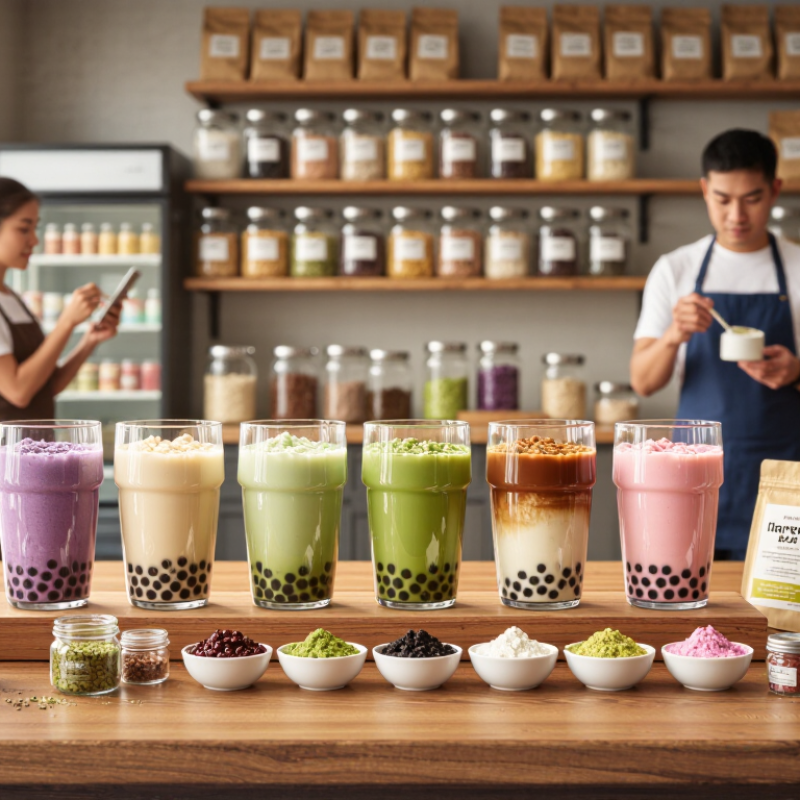
The chart shows typical starting amounts of powder ingredients for one 500 mL bubble tea serving. Dairy-based milk tea powders generally require more powder for body and creaminess, while matcha and fruit powders are commonly used at lower levels to preserve aroma and reduce bitterness.

How to Compare Suppliers, Labels, Costs, and Sustainability in 2026

How to Choose Bubble Tea Powder Ingredients in 2026?

Choosing bubble tea powder now means comparing suppliers beyond price. Request a current specification sheet, allergen statement, microbiological results, and certificate of analysis for every batch. Check protein, sugar, sodium, colourings, and serving size. A low-cost powder may require more grams per cup, increasing the real cost. The Innova Market Insights 2024 trends report identifies health-conscious choices and transparent sourcing as major consumer priorities. That matters at the counter, where customers often read labels while waiting.

Supplier reliability also needs evidence. Review lead times, minimum order quantities, batch consistency, and documented food-safety systems such as ISO 22000 or HACCP-based controls. Ask how the supplier handles recalls and formula changes. The 2024 Global Food Safety Initiative position stresses stronger traceability across food supply chains. Still, certificates are not proof of perfect performance. I would request samples from different production lots and test them in cold and hot drinks. Texture can change surprisingly fast.

Tips: Compare cost per finished cup, not cost per bag. Check whether claims such as “natural” have clear definitions in your market. For sustainability, examine packaging weight, recycled content, transport distance, and disposal instructions. The Ellen MacArthur Foundation continues to report that packaging waste remains a major circular-economy challenge. A lighter pouch may reduce transport emissions, but it may also protect the powder poorly. Record both benefits and trade-offs. Perfect sustainability is unlikely. Better documentation is achievable.

FAQS

Which ingredient details best predict powder quality?

Check tea solids, milk proteins, sweeteners, stabilizers, flavorings, moisture, and particle size. Some samples deceive. Test one spoon in warm water. Watch for sediment, oily rings, or slow dissolving.

What documents should suppliers provide?

Request a current specification sheet, allergen statement, microbiological results, and batch certificate. Each lot matters. The documents should identify testing dates, limits, and production codes.

How can powder safety be checked?

Confirm additive permissions for your destination market. Check allergen controls, heavy metals, hygiene, and traceability. Ask about corrective actions. A safety certificate helps, but it does not prove perfect performance.

How should sugar content be compared?

Compare sugar per prepared serving, not only per 100 grams. A serving can change quickly. Measure the powder, water, ice, and toppings together. Keep free sugars below recommended daily limits where possible.

Which powder suits classic milk tea?

Use black tea powder with dairy or non-dairy creamer. Tea must remain noticeable. A strong tea profile can prevent a flat, cereal-like finish. Adjust sweetness carefully.

What should fruit tea powder provide?

Choose fast-dispersing fruit powder with suitable acidity and limited sediment. Test it in cold water. Creamy ingredients may separate. Do not combine acidic fruit and creamy powders without a stability trial.

How can powder performance be tested properly?

Test hot and cold drinks at serving temperature. Taste them immediately and again after ten minutes. Ice changes everything. I once approved a drink too early. It became overly sweet after melting.

How should supplier costs and sustainability be compared?

Calculate cost per finished cup, including dosage, waste, freight, and preparation. Cheap bags can mislead. Review packaging weight, recycled content, transport distance, and disposal instructions. A lighter pouch may protect powder poorly.

Conclusion

Choosing the right Bubble Tea Powder Ingredients in 2026 requires more than comparing flavors or prices. Milk powders provide creaminess and body, tea powders establish aroma and depth, sweeteners control balance, and flavoring powders create variety. Each ingredient should be evaluated for solubility, consistency, taste, ingredient transparency, shelf stability, and suitability for different preparation methods. Quality standards, allergen information, nutritional values, sourcing practices, and food safety controls also influence the final drink and customer experience.

The best ingredients should match the recipe, whether it is a rich milk tea, a refreshing fruit tea, a low-sugar option, or a dairy-free beverage. Buyers should compare supplier reliability, label accuracy, batch consistency, minimum order quantities, total costs, packaging, and delivery conditions rather than focusing only on the listed price. In 2026, sustainability is also increasingly important, including responsible sourcing, efficient packaging, reduced waste, and practical storage requirements. A careful, balanced evaluation helps create safe, appealing, and consistent bubble tea products.


Emma

Emma

Emma is a dedicated marketing professional with a deep expertise in the company's product offerings. With a passion for effective communication and a knack for connecting with audiences, she plays a pivotal role in driving our marketing strategies forward. Emma regularly contributes to our......