
Latest trends, recipe tutorials, ingredient guides & boba business insights.

Discover popular recipes and menu strategies to elevate your bubble tea store.

Scale your operational performance with 20+ years of wholesale industry experience.
Fast Cook Taro Cube Boba is moving from a niche topping to a practical menu ingredient. Global bubble tea market estimates support this momentum. Grand View Research valued the market at approximately USD 2.75 billion in 2022, with an estimated 8.9% CAGR from 2023 to 2030. These figures vary by research method, but the direction is clear: buyers need speed, consistency, and dependable supply.
Sourcing this product requires more than comparing unit prices. A reliable supplier should provide cooking-time data, ingredient specifications, batch traceability, and a current certificate of analysis. Check the taro content, starch source, cube size, moisture level, and storage conditions. USDA and FAO food-safety guidance also reinforces the importance of hygienic processing, temperature control, and documented traceability. Small details matter. A two-minute cooking difference can change drink texture during a busy afternoon shift.
Consumer expectations add another layer. Innova Market Insights’ 2024 trend reporting highlights interest in convenient products with clear ingredients and credible quality claims. That makes transparent labeling increasingly valuable for importers and beverage chains. Still, sourcing decisions are rarely perfect. A supplier may offer an attractive price but weak packaging. Another may promise fast delivery without proving seasonal capacity. This guide examines five practical checks for Fast Cook Taro Cube Boba, from supplier verification to sample testing and landed-cost review. The goal is not simply faster cooking. It is a stable topping that reaches the cup safely, consistently, and with fewer unpleasant surprises.
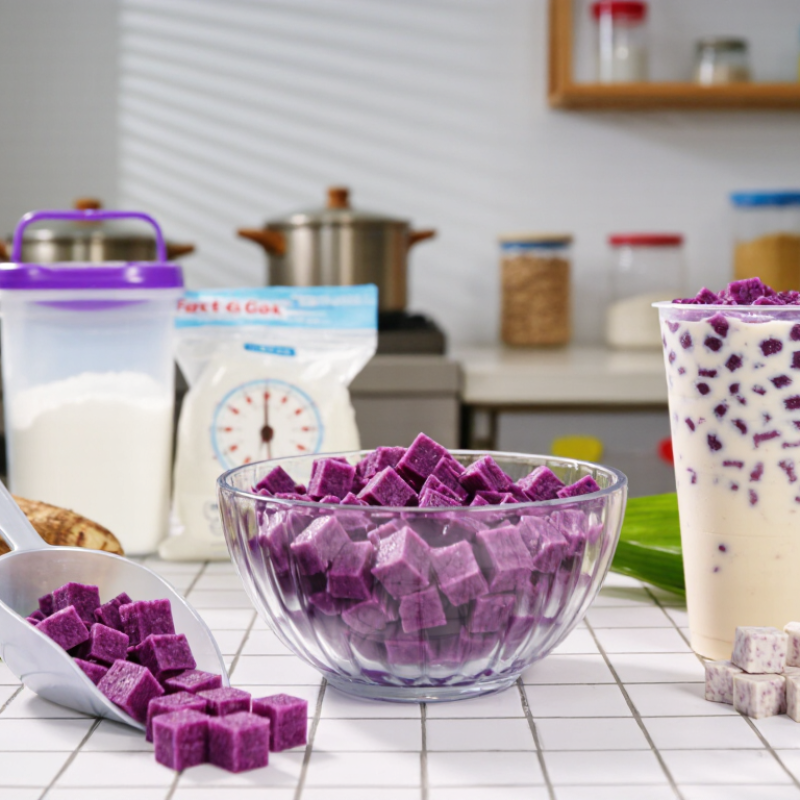
5 Tips for Fast Cook Taro Cube Boba Sourcing
Define the product before contacting suppliers. Grand View Research estimated the global bubble tea market at about USD 2.75 billion in 2022, with continued growth expected through 2030. This growth increases sourcing pressure, but speed alone should not define quality. Specify cube size, target cooking time, center texture, taro flavor strength, color, moisture, and shelf life. A practical starting point is 8–10 millimeter cubes that cook within 5–8 minutes. However, every factory uses different heating equipment. That detail is easy to overlook.
Tip 1: Request a measurable specification sheet. Include raw material ratios, permitted additives, water activity, cooking loss, and texture results after 30 minutes in syrup. Food manufacturers commonly use Certificates of Analysis to verify moisture, microbiological safety, and batch consistency. Ask for three production samples, not one. One sample can look perfect by accident.
Tip 2: Test the cubes in your actual service process. Record water temperature, cooking time, cooling method, and holding conditions. The International Food Information Council’s consumer research shows that convenience strongly influences food choices, yet convenience cannot replace sensory consistency. Check whether the cubes stay chewy, separate cleanly, and retain taro aroma during peak service. Confirm packaging performance during transport, including crushed pieces and moisture migration. Tip 3: Approve suppliers only after reviewing traceability records, audit results, and corrective-action history. A small pilot order is safer than a large commitment. Recheck specifications every season, because crop variation can change color, aroma, and starch behavior.
Typical sourcing benchmarks for cube size and cooking performance
Smaller taro cubes generally cook faster and provide more consistent texture. For fast-cook applications, specify a uniform cube size of approximately 8–10 mm and target a cooking time of about 5–7 minutes. Confirm the final specification through supplier samples, texture testing, moisture analysis, and package-label requirements.
5 Tips for Fast-Cook Taro Cube Boba Sourcing
Fast-cook taro cube boba needs more than attractive samples. Evaluate supplier quality, production capacity, and response speed together. The FDA Food Code 2022 sets 57°C as the minimum hot-holding temperature for many cooked foods. Ask suppliers for cooking trials, cooling records, and storage instructions. Tip 1: Request three production-lot samples, not one. Check cube size, color, bite, swelling, and breakage after cooking.
Capacity must survive demand spikes. A supplier may promise 20 tonnes monthly, yet lack reserve starch, packaging, or labor. Review six months of production records, maximum weekly output, and backup raw-material plans. FAOSTAT’s crop database supports origin and production verification, but agricultural volume does not guarantee processing capacity. Tip 2: Require a written capacity plan for normal and peak orders. Include lead time, minimum order quantity, and emergency allocation.
Response speed is a practical quality signal. Ask five technical questions and measure the reply time. A reliable team should provide specifications, allergen controls, certificates, and corrective-action records without repeated reminders. Tip 3: Set a 24-hour response target and test it before signing. Tip 4: Conduct a video audit, then arrange an independent inspection when possible. Tip 5: Score suppliers monthly using defect rate, on-time delivery, and complaint closure time. My own mistake was trusting fast replies too early. Speed helps, but documented evidence matters more.
Fast-cook taro cube boba sourcing should begin with ingredient verification, not price comparison. Request a complete formula, including taro powder, starches, sweeteners, colors, and processing aids. Check each ingredient against the supplier’s specification and recent certificate of analysis. Test samples for moisture, microbial safety, heavy metals, pesticides, and undeclared allergens. Taro ingredients can vary in color and aroma between harvests. That variation deserves attention. The FAO’s State of Food and Agriculture reports that 14% of food is lost between harvest and retail, showing why raw-material control matters.
Certifications should match the actual production site and product scope. Review current HACCP, ISO 22000, FSSC 22000, or BRCGS documents, then confirm audit dates and corrective actions. A certificate alone is not proof of consistent quality. Ask for batch records and traceability exercises. For packaging, choose sealed bags with strong moisture and oxygen barriers. Request seal-strength, leakage, migration, and transport testing. A crushed carton can expose powder to humidity before arrival. The FDA Food Code 2022 uses 5°C or below for cold holding and 57°C or above for hot holding; these controls matter during preparation and service.
Shelf life should rely on real-time studies, supported by accelerated testing. Ask whether the stated period covers unopened and opened packages. Compare texture after cooking at the buyer’s actual time and temperature. Three minutes may become five. That changes chewiness. One weak point remains: suppliers sometimes provide polished documents but limited lot data. Keep retention samples, review results quarterly, and reject unexplained changes.
Sourcing fast-cook taro cube boba requires more than a low quoted price. Request matching samples from at least three suppliers. Cook each sample with the same water volume and timing. Record cube size, chewiness, taro aroma, color stability, and cooking loss. Small differences matter. Ask for ingredient specifications, shelf-life data, and batch testing records. This evidence helps separate consistent quality from a lucky sample.
Compare prices using the same basis, such as cost per kilogram delivered to your warehouse. Include packaging, inland transport, customs-related charges, and temperature requirements. A cheaper offer may become expensive after these additions. Check minimum order quantities against your actual trial demand. A large MOQ can trap cash and create aging inventory. I once treated MOQ as a minor detail; that assumption delayed a launch. That mistake was avoidable.
Confirm production lead time, dispatch days, transit estimates, and backup plans in writing. Ask whether samples and bulk goods come from the same production line. Request carton dimensions and pallet counts before booking freight. For urgent projects, keep safety stock or split the order. Do not accept “fast delivery” without a dated schedule. Suppliers should explain delays clearly. Forecasts can still be wrong, especially around holidays. Review every comparison after the first shipment, because real performance may challenge your spreadsheet.
| Comparison Item | Supplier Option 1 | Supplier Option 2 | Supplier Option 3 | Supplier Option 4 |
|---|---|---|---|---|
| Product format | Pre-cooked frozen taro cubes | Quick-cook dried taro-flavored tapioca cubes | Frozen taro-filled tapioca cubes | Shelf-stable retort taro cubes |
| Typical cube size | 10–12 mm | 8–10 mm | 12–15 mm | 10–12 mm |
| Sample quantity | 500 g–1 kg | 500 g–1 kg | 500 g–1 kg | 10–20 retail packs |
| Sample preparation time | 2–5 business days | 3–7 business days | 5–10 business days | 3–7 business days |
| Cooking time | 3–5 minutes; then rinse and soak | 5–8 minutes; then rinse and soak | 4–6 minutes; then rinse and soak | Ready after heating; follow pack instructions |
| Indicative bulk price | US$1.80–3.20/kg | US$2.20–4.00/kg | US$2.80–5.00/kg | US$2.50–4.50/kg equivalent |
| Typical minimum order | 100–300 kg | 200–500 kg | 300–1,000 kg | 500–2,000 kg |
| Packaging options | 1 kg bags; 10 kg cartons | 500 g or 1 kg bags; 10 kg cartons | 1 kg bags; 15–20 kg cartons | 250–500 g pouches; master cartons |
| Shelf life | 12–18 months frozen | 12–18 months unopened and dry | 12 months frozen | 12–24 months unopened |
| Storage requirement | Frozen at −18°C or below | Cool, dry storage; protect from moisture | Frozen at −18°C or below | Ambient storage; avoid heat and sunlight |
| Estimated production lead time | 7–14 days after order confirmation | 10–20 days after order confirmation | 15–30 days after order confirmation | 15–30 days after order confirmation |
| Estimated delivery time | Air: 3–7 days; sea: 20–35 days | Air: 4–8 days; sea: 20–40 days | Air: 4–10 days; sea: 25–45 days | Air: 4–10 days; sea: 20–40 days |
| Best fit for | Fast service trials and frozen distribution | Lower cold-chain dependence and dry storage | Premium texture and larger cube presentation | Convenience retail and ambient logistics |
| Key verification before purchase | Cold-chain records, cooking loss, texture after thawing | Moisture protection, rehydration time, ingredient list | Filling ratio, breakage rate, frozen transport conditions | Retort process, pouch integrity, ambient shelf-life validation |
Note: Price ranges, minimum orders, lead times, and freight schedules are typical industry estimates for comparison only. Actual terms vary by specification, order volume, destination, packaging, season, and trade terms.
When sourcing fast-cook taro cube boba, production terms should be confirmed before price negotiations end. Ask for the taro percentage, cube size, cooking time, moisture range, and ingredient specification. Request a retained sample from the exact production line. A beautiful sample proves little. Confirm the batch code, test date, and storage history. In practical sourcing work, these details reveal whether the supplier can repeat texture, color, and swelling performance.
Build the supply plan around measurable commitments. Record minimum order quantity, monthly capacity, lead time, packaging format, pallet quantity, and loading schedule. Put acceptable tolerances in writing. For example, define cube dimensions and the maximum percentage of broken pieces. Confirm whether production stops during seasonal maintenance or raw material shortages. Our early forecast was too optimistic. We underestimated holiday demand and needed costly air freight. That mistake showed why safety stock deserves a clear formula, not a guess.
Use a purchase calendar with three checkpoints: forecast approval, pre-production inspection, and final release. Ask for photos of packed cartons, batch records, and a certificate of analysis when applicable. Check that inner bags remain sealed after handling. Do not rely only on one successful shipment. Keep a backup production window and review supplier performance after each delivery. Some plans still fail. Weather delays, port congestion, or a texture shift can expose weak assumptions. A reliable partnership grows from honest records and fast corrective action.
Specify cube size, cooking time, center texture, taro flavor, color, moisture, and shelf life.
Request three samples from separate production lots.
Use your actual cooking process, including water temperature, cooking time, cooling, and holding conditions.
Request the complete formula, ingredient specifications, processing aids, and recent laboratory results.
Review six months of production records and maximum weekly output.
No. Fast replies are useful, but documented evidence matters more.
Choose sealed bags with strong moisture and oxygen barriers.
Ask for real-time shelf-life studies and supporting accelerated tests.
Sourcing Fast Cook Taro Cube Boba successfully begins with clear product specifications. Define the required cube size, color, texture, cooking time, flavor profile, sweetness level, ingredient preferences, and storage conditions before contacting suppliers. Then evaluate potential suppliers based on product quality, production capacity, communication efficiency, and response speed. A supplier that can provide consistent quality and timely updates is more likely to support long-term business needs.
Before making a purchase decision, verify the ingredient list, relevant certifications, packaging format, shelf life, and storage instructions. Request samples to compare texture, taste, appearance, cooking performance, and consistency. At the same time, review pricing, minimum order quantities, production schedules, and delivery times. Finally, confirm payment terms, quality standards, inspection procedures, shipping responsibilities, and procedures for handling unexpected issues. A detailed supply plan, regular communication, and careful supplier assessment can help reduce purchasing risks and ensure a stable supply of Fast Cook Taro Cube Boba.