Latest trends, recipe tutorials, ingredient guides & boba business insights.
Discover popular recipes and menu strategies to elevate your bubble tea store.
Scale your operational performance with 20+ years of wholesale industry experience.
Choosing the right Jasmine Green Tea Wholesale supplier in 2026 requires more than comparing prices. Buyers must examine leaf quality, jasmine origin, scenting methods, production records, and delivery reliability. A low quote may hide older tea, weak fragrance, or inconsistent batches.
Tea writer and educator James Norwood Pratt wrote, “Jasmine tea is the most popular scented tea in China.” Its popularity still depends on careful craftsmanship. Fresh jasmine blossoms are layered with green tea, sometimes repeatedly, to create a clear floral aroma. The best suppliers can explain these cycles, not simply describe the tea as “premium.”
This guide examines the 2026 Top Jasmine Green Tea Wholesale Suppliers through practical purchasing criteria. It considers tea-growing regions, harvest seasons, minimum order quantities, private-label support, laboratory testing, packaging quality, and export experience. Samples matter. A dry leaf may look bright, yet the brewed cup can taste flat or overly perfumed.
Ask for traceability documents.
Also check storage conditions. Heat and moisture can dull jasmine’s fragrance before the shipment reaches your warehouse. Reliable suppliers provide consistent specifications, responsive communication, and realistic lead times. Certifications can support trust, but they should be verified rather than accepted blindly.
No ranking is permanent. Freight costs, harvest quality, and supplier capacity may change during 2026. Some smaller producers may offer exceptional tea but lack polished websites. That is an uncomfortable limitation. Therefore, this overview favors evidence, tasting results, and transparent business practices over marketing language. The final choice should match your market, budget, and quality expectations.
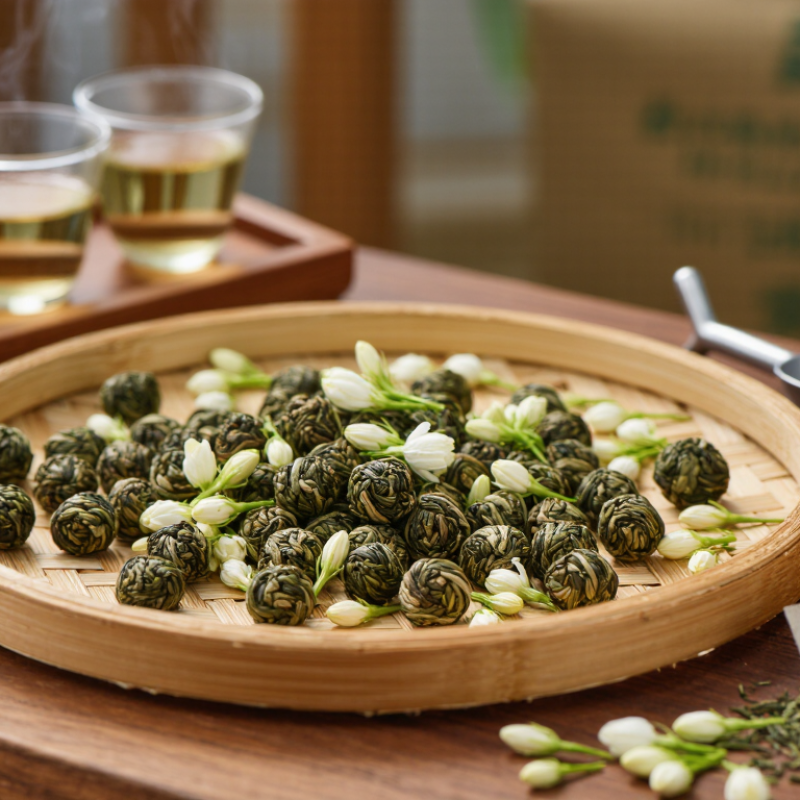
Jasmine green tea combines green tea leaves with the fragrance of jasmine blossoms. The leaves are usually pan-fired or steamed, then exposed to fresh flowers during controlled scenting. This process can be repeated several times. More scenting does not always mean better quality. A clean floral aroma should support the tea’s vegetal, lightly sweet character. In practical sourcing, buyers should request harvest information, origin details, moisture data, and batch samples. A sample reveals more than a polished product sheet. Look for bright, fairly whole leaves, a dry finish, and no heavy perfume. Some variation is normal.
Wholesale distribution exists because cafés, retailers, hotels, and food-service operators need consistent volume. Bulk purchasing can reduce packaging and handling costs, while scheduled orders help protect supply continuity. However, low price alone can hide stale tea, weak traceability, or excessive flavoring. Reliable suppliers should explain storage conditions, lot identification, testing practices, and expected shelf life. They should also provide food-safety documents appropriate to the destination market. Ask how the tea is packed. Inner liners, sealed cartons, and cool, dry storage matter during transport. Pricing should be compared by usable kilogram, not simply by carton. I would also test the infusion after ten minutes, although that may expose flaws a quick tasting misses. Wholesale decisions are not perfectly predictable; seasonal aroma changes can still require adjustment.
In 2026, identifying a reliable jasmine green tea wholesale supplier requires more than comparing prices. Start with product evidence. Ask for the tea’s harvest season, growing region, leaf grade, and jasmine-scenting method. A professional supplier should provide recent laboratory reports for pesticide residues, heavy metals, and microbial safety. Check whether each report matches the exact batch offered, not a similar product.
Request a small sample before discussing large volumes. Brew it with measured water at around 80°C, then examine the pale liquor, fresh floral aroma, and clean finish. Watch for harsh bitterness, dusty leaves, or an artificial perfume smell. Reliable suppliers usually explain storage conditions, packaging materials, minimum order quantities, and realistic delivery times. Traceability matters too. You should know who processed the tea and how the batch was sealed. No supplier looks perfect on paper. Some documents may be incomplete, and that deserves careful follow-up.
Tips: Compare at least three suppliers using the same checklist. Ask for production photos, but do not treat photos as proof. Verify certificates through their issuing organizations when possible. Discuss private labeling only after quality is confirmed. Keep written records of sample results, agreed specifications, and shipment tolerances. If a supplier avoids simple technical questions, pause the negotiation. Cheap tea can become expensive after customer complaints, rejected stock, or faded aroma. Also, review communication speed and accuracy. Small mistakes in weight, dates, or packaging details can reveal larger operational weaknesses.
Finding reliable jasmine green tea wholesale suppliers in 2026 requires more than comparing prices. A dependable supplier should explain the tea’s growing region, harvest season, processing method, and jasmine-scenting process. Ask for recent samples before discussing large orders. The dry leaves should look reasonably uniform, while the brewed tea should have a clean floral aroma, fresh taste, and limited bitterness. Strong perfume notes can hide stale or low-grade tea.
In my purchasing experience, clear documentation often separates serious suppliers from casual traders. Request a batch-specific certificate of analysis, pesticide testing, moisture results, and full traceability records. Confirm minimum order quantities, packaging options, storage conditions, lead times, and replacement policies in writing. A useful supplier will answer practical questions without rushing the sale. They should also provide export experience and explain how tea is protected from heat, light, and moisture during transport. Small details matter.
Do not rely on polished photographs alone. Contact references when possible, inspect the packaging, and test the same batch again after delivery. Even experienced buyers can overlook inconsistent scenting between lots. That weakness deserves attention. A short trial order, transparent communication, and independent quality checks create stronger protection than a low quotation. Suppliers who welcome reasonable verification are usually better partners for steady wholesale purchasing.
A practical, brand-neutral comparison of major sourcing channels and supplier requirements
| Supplier Category | Main Sourcing Area | Common Product Formats | Typical Wholesale MOQ | Best Use Case | Key Documents to Request | Reliability Checks | Overall Suitability |
|---|---|---|---|---|---|---|---|
| Tea factories near jasmine-growing areas | Guangxi, China, especially areas around Hengxian | Loose-leaf tea Tea bags Scented pearls | Usually 25–100 kg for standard products; custom orders may require more | Importers and distributors seeking large-volume jasmine green tea with direct factory communication | Product specification, recent COA, pesticide-residue report, food-safety certificate, origin information | Confirm scenting cycles, tea-to-flower ratio, batch consistency, production capacity, and export experience | ★★★★★ |
| Specialty tea manufacturers | Fujian and Zhejiang, China | Silver needle style Jasmine pearls Premium loose leaf | Often 10–50 kg for existing grades; private-label quantities vary | Premium retailers, tea houses, hospitality groups, and gift-product developers | Grade description, harvest season, sensory profile, allergen statement, packaging specification | Request pre-shipment samples, infusion photographs, aroma evaluation, and independent laboratory testing | ★★★★★ |
| Large export-oriented tea processors | Major tea-processing regions in eastern and southwestern China | Bulk cartons Tea bags Foodservice blends | Commonly 100–500 kg for regular bulk grades | Supermarket supply, beverage companies, foodservice, and national distribution | HACCP or equivalent food-safety records, ISO-related certificates where applicable, COA, packing list | Review annual capacity, lead-time history, container-loading procedures, and traceability system | ★★★★☆ |
| Private-label tea packers | China, India, Sri Lanka, and other established tea-packing markets | Pyramid bags Paper sachets Retail tins | Typically 5,000–20,000 retail units, depending on packaging design | New brands, hotels, cafés, corporate gifting, and retail launches | Artwork requirements, packaging material specifications, food-contact declaration, barcode guidance | Check filling accuracy, seal integrity, packaging samples, print approval process, and production schedule | ★★★★☆ |
| Organic-certified tea suppliers | Certified growing regions in China, India, and other tea-producing countries | Organic loose leaf Organic tea bags Certified blends | Usually 25–100 kg for bulk supply; certified private label may require higher volumes | Natural-food retailers and markets where organic claims are commercially important | Valid organic certificate, scope of certification, transaction certificate when required, COA | Verify certificate number, issuing body, product scope, expiry date, and separation from conventional stock | ★★★★☆ |
| Fair-trade or ethical-sourcing suppliers | Certified tea supply chains in Asia and selected African tea regions | Loose leaf Tea bags Retail-ready packs | Frequently 50–250 kg for bulk orders; retail formats vary by pack size | Socially responsible retailers, hospitality groups, and institutional buyers | Fair-trade certificate, producer information, social-compliance documentation, COA | Check certificate validity, supply-chain coverage, worker standards, and claim wording for the destination market | ★★★★☆ |
| Regional importers and tea wholesalers | North America, Europe, the Middle East, and Asia-Pacific distribution hubs | Ready-stock bulk tea Foodservice packs Mixed cartons | Often 5–25 kg per SKU, with lower logistical complexity than direct importing | Small businesses needing faster delivery, mixed products, and local support | Country-of-origin information, lot number, COA, food-import compliance records, invoice details | Confirm warehouse conditions, remaining shelf life, lot traceability, and return policy | ★★★★☆ |
| Online B2B tea marketplaces | International supplier networks | Sample packs Bulk loose leaf Custom packaging | Can range from 1 kg samples to container-scale orders | Initial supplier discovery, price comparison, and small-scale product testing | Business registration, product specification, laboratory report, transaction terms, shipping documents | Use verified payment methods, conduct video audits, compare samples, and avoid suppliers refusing documentation | ★★★☆☆ |
| Specialty tea brokers and sourcing agents | Tea-producing regions with local inspection and purchasing networks | Custom grades Seasonal lots Multi-origin sourcing | Flexible; dependent on the selected factory, grade, and contract structure | Buyers needing local language support, factory verification, and multi-supplier coordination | Agency agreement, supplier identity, inspection reports, COA, commission and payment terms | Clarify conflicts of interest, ownership of samples, quality responsibility, and inspection independence | ★★★☆☆ |
Note: MOQ, product formats, certifications, and lead times are indicative wholesale ranges rather than fixed offers. Buyers should verify current specifications, regulatory requirements, laboratory results, and shipping terms directly before placing an order.
2026 Top Jasmine Green Tea Wholesale Suppliers?
What Quality Standards Should Wholesale Buyers Compare?
Wholesale buyers should compare measurable quality, not only bright packaging or a strong jasmine smell. FAOSTAT records global tea production above six million metric tons in recent years. That scale creates wide differences in harvesting, storage, and blending practices. Ask for the exact tea grade, harvest season, origin, and lot code. Fresh green tea should show clean, whole leaves, a lively green liquor, and a soft floral aroma. A harsh perfume note can signal excessive scenting or poor storage.
Laboratory evidence matters. Request a current certificate of analysis for moisture, pesticide residues, heavy metals, and microbiological safety. ISO 11287:2017 defines basic requirements for green tea, while ISO 3103:2019 provides a standardized liquor preparation method. These references make supplier comparisons more consistent. Buyers should also check pesticide limits under the destination market’s rules, such as Regulation (EC) No 396/2005 in the European Union. Compliance claims need lot-specific proof. A generic certificate is not enough.
Tips: Order sealed samples from the intended production lot. Brew them at the same temperature and time. Compare aroma after ten minutes, not only immediately. Check carton liners, pallet conditions, and humidity records. I have seen attractive samples fail after shipping because moisture protection was weak. That remains an uncomfortable reminder: a promising cup does not prove reliable wholesale quality.
2026 Top Jasmine Green Tea Wholesale Suppliers?
How to Choose the Best Supplier for Your Business Needs
Choosing a jasmine green tea supplier requires more than comparing prices. Review the tea’s origin, harvest season, leaf grade, and jasmine scenting process. Ask how many scenting cycles are used. More cycles may create a stronger aroma, but balance still matters. Request recent samples from the exact production batch. Taste them hot and after cooling.
Reliable suppliers provide clear traceability, consistent specifications, and practical quality records. Check moisture control, pesticide testing, allergen statements, and food safety certifications. Ask whether testing is performed by an independent laboratory. Certificates deserve verification, not automatic trust. A professional supplier should explain minimum order quantities, packaging options, lead times, and replacement procedures in writing. Communication speed also matters when your inventory is moving quickly.
Run a small trial order before signing a long-term agreement. Compare aroma, liquor color, bitterness, packaging condition, and delivery accuracy. Keep written tasting notes from several team members. One person’s favorite fragrance may not suit your customers. Avoid choosing the cheapest offer without calculating freight, storage, inspection, and possible waste. No supplier is perfect. A promising sample can still hide inconsistent batches. Ask how the supplier handles crop variation, delayed shipments, and quality complaints. Their answer often reveals more than a polished sales presentation. Recheck performance every few shipments, because a good first order is not permanent proof.
Request the harvest season, growing region, leaf grade, and scenting method. Ask for recent, batch-specific laboratory reports. These should cover pesticides, heavy metals, moisture, and microbial safety. A generic certificate is not enough.
Request a small sample from the intended production batch. Brew it with measured water near 80°C. Check the liquor, floral aroma, bitterness, and finish. The tea should look reasonably clean and uniform. Start small.
A clean floral aroma is usually preferable. Be cautious when the scent resembles strong perfume. That smell may hide stale leaves or excessive scenting. Dusty leaves and harsh bitterness also require investigation.
Traceability shows who processed, packed, and sealed the tea. Ask for the lot code and matching test report. The delivered batch should match the approved sample. This detail is easy to overlook.
Confirm minimum order quantities, packaging materials, storage conditions, and delivery times. Also record replacement policies and acceptable shipment tolerances. Include weight, dates, carton details, and sealing requirements. Small errors can reveal larger weaknesses.
No. Photos are not proof. Use them only as supporting information. Request samples, inspect packaging, and verify certificates when possible. References and independent checks provide stronger evidence.
Compare at least three suppliers using the same checklist. Review quality, communication speed, documentation, and delivery expectations. Do not choose only by the lowest quotation. Cheap tea can become expensive after complaints or rejected stock.
Test the delivered batch again, using the original brewing method. Compare aroma, appearance, taste, and packaging condition. Inspect protection from heat, light, and moisture. A good sample can still fail during shipping. That is an uncomfortable lesson.
Jasmine Green Tea Wholesale offers businesses a practical way to purchase fragrant, floral green tea in larger quantities for resale, hospitality, food service, or private-label projects. This tea combines green tea’s fresh, slightly grassy character with the natural aroma of jasmine blossoms, making it popular among diverse customers. In 2026, buyers should evaluate suppliers based on product consistency, sourcing transparency, production capacity, packaging options, pricing, and communication. Reliable suppliers may be found through tea trade exhibitions, professional directories, manufacturer inquiries, and verified business networks.
Wholesale buyers should compare key quality standards, including leaf appearance, aroma, flavor balance, freshness, moisture control, cleanliness, storage conditions, and batch-to-batch consistency. Certifications, laboratory testing, traceability, and clear documentation can also help confirm product safety and authenticity. The best supplier depends on each business’s needs, such as order volume, target market, delivery schedule, customization requirements, and budget. By requesting samples, reviewing terms carefully, and testing supplier responsiveness, buyers can build a dependable supply relationship and select Jasmine Green Tea Wholesale products that support long-term customer satisfaction.