0%

Non-Dairy Beverage Creamer Powder is moving from a coffee-shop niche into mainstream beverage formulation. Grand View Research estimated the global non-dairy creamer market at approximately USD 6 billion in 2023. Its report also projects continued growth through 2030, supported by plant-based preferences, convenience, and expanding instant-coffee consumption. The exact figure varies by research firm. Definitions differ between powdered creamers, liquid substitutes, and broader dairy-free ingredients.

Food scientist Professor David Julian McClements has described this wider shift simply: “The future of food is plant-based.” His view matters because successful creamer development requires more than removing milk. Manufacturers must balance whiteness, foam behavior, mouthfeel, shelf stability, and clean-label expectations. A spoonful should dissolve quickly in hot coffee, without floating oil or leaving a gritty film.

Recent Innova Market Insights and Mintel reporting also highlights consumer interest in recognizable ingredients and lower environmental impact. Coconut, oat, soy, and glucose-based systems each create different sensory results. Soy may improve protein structure, while coconut can deliver richer texture but stronger flavor. Oat-based formulas often feel familiar, yet their performance depends heavily on processing and emulsification.

This market is promising, but not effortless. Some products still rely on complex stabilizer systems. Some sustainability claims lack comparable evidence. Buyers should examine ingredient origin, allergen controls, nutrition data, and supplier testing before choosing a partner. The best Non-Dairy Beverage Creamer Powder supplier is not simply the lowest-cost factory. It is a technically transparent producer that can repeat quality, explain limitations, and improve the formula when real-world trials expose weaknesses.
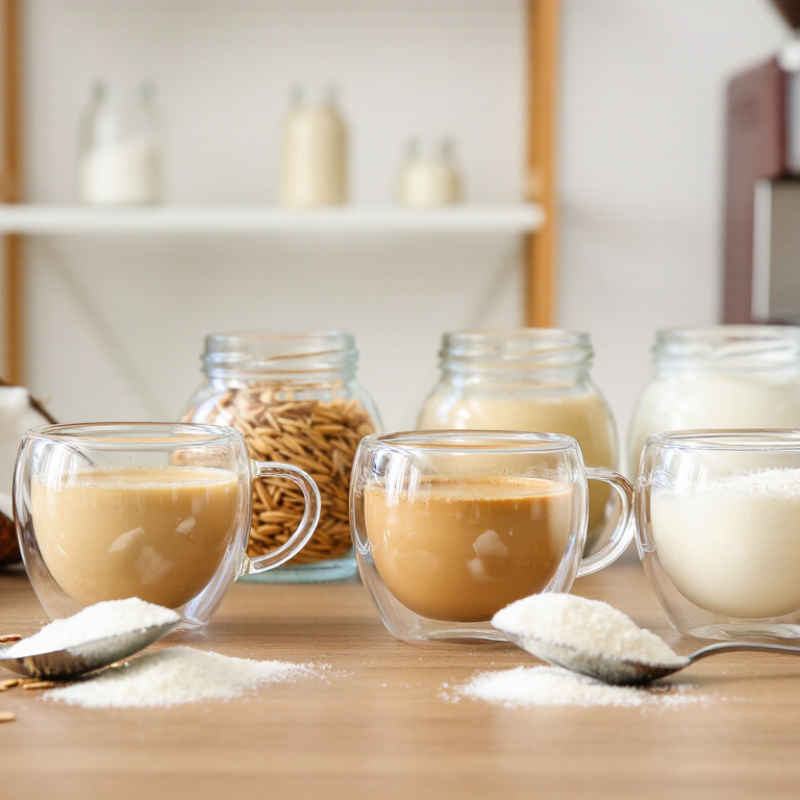
China Best Non Dairy Beverage Creamer Powder Suppliers?

What Is Non-Dairy Beverage Creamer Powder?

Non-dairy beverage creamer powder is a dry, free-flowing ingredient designed to whiten and soften coffee, tea, and powdered beverages. It usually contains vegetable fat, glucose syrup solids, milk-free proteins, emulsifiers, stabilizers, and anti-caking agents. Spray drying turns a liquid emulsion into fine particles that dissolve in hot water. The result is a creamy mouthfeel without liquid milk.

Not every non-dairy creamer is vegan. Some formulas use sodium caseinate, a milk-derived protein, so buyers must check allergen and labeling documents. A reliable supplier should provide specifications for moisture, bulk density, particle size, solubility, fat content, and microbiological limits. In practical testing, the powder should disperse quickly, leave minimal sediment, and remain stable after several minutes in a hot cup. Small details matter.

Grand View Research valued the global non-dairy creamer market at about USD 6.65 billion in 2023 and projected continued growth through 2030. The report links demand with convenience, plant-based preferences, and expanding instant beverage consumption. Those trends are useful, but market size does not prove product quality. I would also test flavor after cooling, because some powders taste acceptable when hot but become waxy later. That weakness is easy to miss. Suppliers in China may offer customized fat levels, particle sizes, and packaging formats, yet independent laboratory verification remains essential before a long-term purchase.

Key Ingredients and Functional Properties of Creamer Powder

China’s non-dairy beverage creamer powder suppliers increasingly focus on ingredient functionality, not only price.

According to Grand View Research’s 2024 market analysis, the global non-dairy creamer market was valued at over USD 6 billion in 2023 and is expected to grow steadily through 2030. This growth reflects demand for convenient, stable, and dairy-free beverage systems.

The core ingredients usually include glucose syrup solids, palm or coconut oil, sodium caseinate, emulsifiers, and anti-caking agents. Plant-based proteins can replace milk-derived caseinate in vegan formulas, but they may reduce whitening strength. It is a practical trade-off.

Emulsifiers help oil disperse in hot coffee, while glucose syrup solids create body and mild sweetness. A well-designed powder should dissolve quickly, resist surface oil, and maintain a smooth mouthfeel.

According to Innova Market Insights, clean-label and plant-based claims remain important drivers in new food and beverage launches. However, “plant-based” does not automatically mean better performance. Humidity can cause caking. High heat can damage flavor.

Supplier tests should measure dispersibility, sediment, whiteness, viscosity, and storage stability. ISO 22000-based food safety systems and documented batch testing also strengthen procurement reliability.

One detail is often missed: regional water hardness can change the final texture. Field testing is still necessary.

How to Evaluate Chinese Non-Dairy Creamer Suppliers

Choosing China’s best non-dairy beverage creamer powder supplier requires more than comparing prices. A reliable evaluation begins with technical specifications, including fat content, protein source, whiteness, solubility, and flavor performance. Ask for a complete ingredient list and a recent certificate of analysis. Confirm whether each batch meets the agreed limits.

Request production samples from different lots. Prepare them in hot coffee, milk tea, and instant beverage formulas. Check dispersibility, sediment, mouthfeel, and aftertaste after ten minutes. Ask for microbiological testing, allergen controls, and heavy metal limits. Evidence matters more than attractive brochures.

Inspect the supplier’s quality system and traceability process. Production records should identify raw materials, batch numbers, packaging dates, and storage conditions. A video tour helps, but an independent audit gives stronger evidence. Ask about minimum order quantities, lead times, moisture protection, and export documentation. Communication also reveals experience; technical replies should be precise, not vague.

Do not trust one successful sample. Keep testing. Suppliers may perform differently during seasonal raw material changes. I would also compare complaint handling before signing a contract. Can the supplier investigate a failed batch and provide corrective action? My checklist still has blind spots, especially when sensory preferences differ between markets. A small pilot order can expose packaging, consistency, and delivery problems before larger commitments.

How to Evaluate Chinese Non-Dairy Creamer Suppliers

Suggested procurement scorecard for comparing non-dairy beverage creamer powder suppliers in China. The weighting totals 100% and reflects the main factors buyers can verify during supplier qualification.

Food safety and regulatory compliance should receive the highest priority, followed by product consistency and application performance. Cost transparency, export documentation, production capacity, and technical support help confirm whether a supplier can support stable long-term procurement.

Top Supplier Selection Criteria for Beverage Manufacturers

China Best Non Dairy Beverage Creamer Powder Suppliers?

Top Supplier Selection Criteria for Beverage Manufacturers

Selecting a Chinese non-dairy creamer powder supplier requires more than comparing quotations. Grand View Research estimates the global non-dairy creamer market will expand steadily through 2030, increasing pressure on manufacturers to secure consistent supply and quality. Ask for batch records, allergen controls, microbiological results, and full ingredient specifications. A polished sample is not enough.

Food safety systems matter. Prefer suppliers operating under ISO 22000 or another GFSI-recognized scheme, with traceable raw materials and documented corrective actions. Check whether their testing covers moisture, particle size, solubility, heavy metals, and microbial limits. These details affect sediment, foam stability, and dispensing speed on a real production line. Request three production batches, not one laboratory sample.

Cost needs context. A cheaper powder may create clogged valves, uneven whitening, or extra waste during filling. The Institute of Food Technologists identifies stability, functionality, and clean-label expectations as important development factors for powdered beverage systems. Ask for pilot-trial data at your actual temperature, water hardness, and mixing time. I would also review lead-time records and minimum order quantities. Small inconsistencies become expensive quickly.

Supplier communication deserves testing. Can the technical team explain a failed solubility result clearly? Can they provide revised documents without delay? Sometimes, no. A factory audit, video or in-person, should examine hygiene zoning, calibration records, warehouse humidity, and packaging seals. Grand View Research reports continued market growth, but growth alone does not prove manufacturing reliability. Your process conditions must decide.

Applications, Quality Standards, and Purchasing Considerations

China’s non-dairy beverage creamer powder suppliers serve coffee, milk tea, cocoa, vending, and bakery applications. The right powder depends on the final drink, not only its price. A vending formula may need fast dispersion, while café use may require a smoother mouthfeel and stronger whitening effect. Some products contain sodium caseinate, a milk-derived ingredient, so “non-dairy” does not always mean vegan. Check the ingredient statement carefully.

Quality control should include a current certificate of analysis for every production batch. Review moisture, fat content, microbiological limits, solubility, particle size, and heavy-metal testing. Food-safety systems such as HACCP or ISO 22000 can show process discipline, but certificates alone are not enough. Ask for allergen controls, traceability records, and packaging specifications. A clean powder should dissolve without excessive floating oil, harsh aftertaste, or visible sediment.

Purchasing decisions should begin with application trials. Test samples in the actual coffee, tea, or beverage machine. Measure whitening, sweetness, foam stability, and storage performance after opening. Request production lead time, minimum order quantity, carton weight, inner-bag material, and recommended storage humidity. A low quotation may hide weaker fat sources or unstable batches. I would avoid approving a supplier from one attractive sample. Batch consistency matters more. Even careful evaluations can miss seasonal changes in raw materials, so periodic retesting remains necessary.

China Best Non-Dairy Beverage Creamer Powder Suppliers? — Applications, Quality Standards, and Purchasing Considerations

Evaluation Dimension Typical Commercial Information Application Relevance Purchasing Checkpoints
Product Definition A powdered creaming ingredient designed to whiten beverages, improve mouthfeel, and reduce perceived bitterness. “Non-dairy” does not always mean vegan. Coffee, tea, instant beverages, vending mixes, cereal drinks, and powdered nutrition beverages. Confirm whether the formula is dairy-free, lactose-free, or fully plant-based. Check allergen declarations and the presence of sodium caseinate or other milk-derived ingredients.
Common Ingredient Structure Usually includes glucose syrup solids or maltodextrin, vegetable fat, a protein or emulsifier system, stabilizers, anti-caking agents, and permitted flavors or colors. Each component affects whitening, dispersion, foam stability, heat tolerance, flavor release, and storage performance. Request the full ingredient statement, allergen statement, GMO status, additive list, and processing-aid information before approval.
Fat Source Vegetable fat is commonly based on coconut, palm kernel, palm, or other permitted plant oils. The selected fat influences melting behavior and creaminess. Coconut-based systems can provide a clean creamy profile; palm-based systems are often selected for cost and powder functionality. Verify the oil source, hydrogenation status, trans-fat specification, saturated-fat declaration, sustainability requirements, and country-specific labeling rules.
Typical Fat Level Many beverage creamer powders are formulated within an approximate 20%–40% fat range, although low-fat and specialty products may fall outside this range. Higher fat levels generally produce a richer body, while lower fat levels can support lighter beverages and cost control. Use the supplier’s product specification and certificate of analysis rather than relying on a general market range.
Moisture and Water Activity Spray-dried powders commonly target moisture below approximately 5%; the exact limit depends on the formulation and packaging system. Lower moisture and controlled water activity help reduce caking, microbial risk, and quality deterioration during storage. Specify moisture, water activity, test methods, shelf-life conditions, and the acceptable variation between batches.
Particle and Powder Performance Important characteristics include bulk density, particle-size distribution, flowability, dispersibility, wettability, and resistance to caking. Good instant performance supports rapid dissolution in hot or cold beverages and improves filling accuracy in sachets and vending systems. Request application test results using the intended beverage temperature, dosage, mixing time, and water hardness.
Recommended Applications Instant coffee, milk tea, chai, cocoa drinks, flavored powders, vending beverages, ready-to-mix nutrition drinks, and food-service beverage bases. The best formula depends on acidity, serving temperature, agitation method, target whitening, and desired creaminess. Ask for samples tested in the final beverage recipe instead of evaluating the powder alone.
Heat and Acid Stability Performance varies with pH, mineral content, temperature, protein system, and emulsifier selection. Acidic beverages require specialized stabilization. Poor compatibility may cause oil separation, feathering, sedimentation, or loss of whitening in coffee and tea. Conduct hot-coffee, hot-tea, cold-mix, and acidity compatibility tests under real operating conditions.
Food Safety Systems Credible facilities may operate HACCP-based controls and hold certification such as ISO 22000, FSSC 22000, or BRCGS, depending on the market served. A certified food-safety system supports hazard control, traceability, sanitation, corrective actions, and recall readiness. Verify certificate validity, certification scope, issuing body, manufacturing site, audit status, and product-category coverage.
China Regulatory Compliance Products manufactured or sold in China should be assessed against applicable national food-safety standards, including GB 2760, GB 7718, GB 28050, and GB 14880 where relevant. These standards address permitted food additives, labeling, nutrition information, and permitted nutrient fortification. Confirm the applicable standard for the exact product category, intended market, ingredients, additives, claims, and packaging language.
Microbiological Controls Routine controls commonly address total plate count, yeast and mold, coliforms, Salmonella, and other pathogens or indicators required by the applicable specification. Microbiological quality is essential because the powder may be used without a kill step by the final consumer. Review recent batch test results, sampling plans, laboratory methods, pathogen criteria, and environmental-monitoring procedures.
Contaminant and Residue Testing Depending on ingredients and destination, testing may include heavy metals, mycotoxins, pesticide residues, mineral-oil hydrocarbons, and other regulated contaminants. Risk level is influenced by the oil source, agricultural raw materials, processing aids, and supply-chain geography. Define the required analytes, limits, laboratory accreditation, test frequency, and compliance standard before placing an order.
Allergen and Dietary Claims Possible claims include dairy-free, lactose-free, vegan, non-GMO, gluten-free, Halal, and Kosher; each claim has different verification requirements. Claims affect consumer eligibility, export labeling, retailer approval, and the choice of ingredients and production controls. Request certificates, allergen-control procedures, cross-contact assessments, segregation details, and claim substantiation documents.
Packaging and Shelf Life Common formats include multi-wall bags with moisture barriers, lined sacks, and bulk bags. Shelf life is formulation- and packaging-dependent and often ranges from 12 to 24 months when properly stored. Barrier packaging helps protect against moisture uptake, oxidation, odor absorption, and loss of powder flowability. Confirm packaging material, net weight tolerance, palletization, storage temperature, humidity limits, lot coding, and remaining shelf life at shipment.
Documentation Package A professional supply package generally includes a technical data sheet, specification, certificate of analysis, ingredient statement, allergen declaration, SDS where applicable, and traceability information. Complete documentation supports regulatory review, import clearance, quality release, and customer audits. Make document delivery and revision control contractual requirements, including notification of ingredient, process, or site changes.
Sampling and Validation A meaningful evaluation should compare laboratory samples, pilot batches, and production batches using the same recipe and mixing procedure. Validation identifies differences in flavor, whiteness, sedimentation, foam, dissolution speed, and batch-to-batch consistency. Define sample quantity, acceptance criteria, retention samples, change-control rules, and the process for handling nonconforming batches.
Commercial Purchasing Factors Total cost includes ingredient price, formulation development, packaging, testing, freight, customs, storage, minimum order quantity, and payment terms. The lowest unit price may not provide the lowest total cost if the powder has poor dispersion, high waste, short shelf life, or inconsistent quality. Compare landed cost, annual capacity, lead time, minimum order quantity, production continuity, insurance, incoterms, and complaint-response procedures.

Note: Typical ranges and requirements are for preliminary supplier screening only. Final specifications must be confirmed against the supplier’s current technical documents, applicable Chinese regulations, and the destination market’s requirements.

FAQS

What ingredients are commonly used in non-dairy creamer powder?

Common ingredients include glucose syrup solids, vegetable oil, emulsifiers, and anti-caking agents. Some formulas use milk-derived caseinate. Plant proteins can replace it, but whitening may decrease.

Does “non-dairy” always mean vegan?

No. Some non-dairy creamers contain sodium caseinate, which comes from milk. Check the complete ingredient statement carefully. The label can surprise you.

How should I test a creamer powder before purchasing?

Test samples in the actual coffee, tea, cocoa, or beverage machine. Check dispersibility, whitening, sediment, sweetness, and mouthfeel. Inspect the drink again after ten minutes.

What quality documents should suppliers provide?

Request a current certificate of analysis for every production batch. Review moisture, fat content, microbiological results, particle size, and heavy-metal limits. Ask for allergen controls and traceability records.

Why can the same powder perform differently in different regions?

Water hardness can change texture, dispersion, and mouthfeel. Humidity may cause caking during storage. Field testing remains necessary.

What should I inspect in a supplier’s production process?

Check raw-material records, batch numbers, packaging dates, and storage conditions. An independent audit provides stronger evidence than a video tour. Certificates alone are not enough.

Which properties matter for vending and café applications?

Vending formulas often need rapid dispersion and low sediment. Café applications may require stronger whitening and smoother mouthfeel. Choose according to the final drink.

What purchasing details should be confirmed before signing a contract?

Confirm minimum order quantity, production lead time, carton weight, inner-bag material, and storage humidity. Discuss complaint handling and corrective actions. My checklist is not perfect.

Why should buyers avoid approving a supplier from one attractive sample?

One successful sample can hide seasonal raw-material changes or unstable batches. Compare samples from different production lots. A small pilot order can reveal packaging and delivery problems.

Conclusion

Non-Dairy Beverage Creamer Powder is a versatile ingredient used to improve the creaminess, flavor, color, and mouthfeel of coffee, tea, cocoa, instant drinks, and other beverage products without using traditional dairy cream. Its performance depends on ingredients such as plant-based fats, glucose syrup solids, milk-free proteins, stabilizers, emulsifiers, and flow agents. These components help create consistent dispersion, smooth texture, balanced taste, and good storage stability.

When evaluating Chinese suppliers, beverage manufacturers should consider formulation expertise, production capacity, food safety systems, quality consistency, customization ability, packaging options, and export experience. Suppliers should provide clear specifications, ingredient declarations, allergen information, testing records, and samples for application trials. Purchasing decisions should also consider the intended beverage, dosage, solubility, shelf life, regulatory requirements, minimum order quantity, lead time, and total cost. A reliable supplier should combine stable quality, responsive technical support, transparent communication, and flexible service to meet different product development and manufacturing needs.


Isabella

Isabella

Isabella is a dedicated marketing professional with an exceptional grasp of the company's products and services. With a deep understanding of market dynamics and consumer behavior, she consistently crafts compelling content that resonates with our audience. Isabella takes charge of our website’s......